How does knowing about literary elements impact understanding a story?
When I think back to elementary school and the projects and activities that went along with reading a particular book the only thing that comes to mind are worksheets or book jackets where we were told to fill out the basics: characters, plot, setting, and mood. Although these are essential literary elements, we were never encouraged to use them in a way that made the reading as meaningful as possible to us. We were only obligated to scratch the surface of these elements but never truely think about them and their impact in the reading. While reading, the reader should always be thinking about each literary element, character, point of view, time, place, plot, mood, symbol, and theme, however, just thinking about these on the surface is not enough. In order for readers to dive deep into the story being read, thinking, discussing, and connecting these elements needs to be done. In my opinion, discussion is key. This allows students to hear differing points of view on the story and relate them to their own ideas and through this process deeper meaning is drawn from the text and ultimately a stronger understanding of the authors message is achieved.
Tuesday, September 28, 2010

The Very Hungry Caterpillar

Title: The Very Hungry Caterpillar
Author: Eric Carle
Age Level: 3+
Rating: 5 out of 5
Summary
This book follows a caterpillar around for a week and we are able to see the different foods that the caterpillar eats such as apples, pears, plums, strawberries, oranges, and a lot of junk food. The caterpillar grows from a little caterpillar to a big fat caterpillar and takes a break to make a cocoon where he can rest for two weeks. When he decides to come out, we find that he has turned into a beautiful, colorful butterfly!
Opinion
The Very Hungry Caterpillar is just another memorable book from my childhood by Eric Carle. This book is on my top 10 list of books I loved while growing up. Again, in this book, Carle uses collage art in an outstanding way that gives such uniqueness and appeal to his work. Although his illustrations are quite simple, the colors are so vibrant, your eye immediately is drawn towards them and you brought into the world of the caterpillar. Another unique element in his book is the flaps where the fruit he eats is shown. The flaps start with one apple, then two, pears, three, plums, four strawberries, and five oranges. Having these flaps allows for the reader to become actively engaged in the story which I think is very important and is something that, in my opinion, holds the readers attention. I think that Eric Carle is one of the best authors of children's books because he incorporates important lessons into his stories that readers pick up on and are able to practice while reading. In this book, he introduces sets of objects up to ten, the fruit he ate, as well as the names of the days of the week. Along with these, he is able to tell the amazing and interesting story of the transformation of a caterpillar into a butterfly. All of these lessons are incorporated very harmoniously into a truely memorable book.
This book would definitly be a part of my curriculum because I think that it encorporates so many essential lessons for young readers and is one that children will really enjoy reading. I asked my child study student what her favorite books were and The Very Hungry Caterpillar was first out of her mouth. A fun activity to do with this book would be having a real caterpillar in class and watching it turn into a butterfly over time.
Froggy Goes to Camp
 Picture Book
Title: Froggy Goes to Camp
Author: Jonathon London
Illustrator: Frank Remkiewicz
Age Level: 3+
Rating: 4 out of 5
Summary
In this book, it is the beginning of summer and Froggy is very excited and anxious to go to Camp Run-A-Muck for the first time. He forgets to pack his bathing suit and sleeping bag so the trip to camp takes longer than expected but upon his arrival he is greeted by his friendly counselors and bunkmates. Throughout Froggy's time at camp he finds himself in food fights, overturning kayaks on the lake, and messing with his principal.
Opinion
I chose this book because my child study student's favorite animals are frogs and this author has a series of books about Froggy and his adventures so I thought I'd give them a shot. I thought that the illustrations in the book were very inviting with the use of cartoon art as the design style. I think that using this art style in picture books is very captivating for young readers and create excitement while viewing the text. I also liked how the author used catchy phrases throughout the story such as, "At sunrise, a bugle blasted--da-da ta-DOT ta-daaa!", and "Froggy hopped out of bed, got dressed--zap! zip! zoop! zup! zut! zut! zut!--". Even while I read this I found myself chanting these lines in my head the way a young reader would say them while reading this book. I think having dialogue like this, where the action happening or the sound happening is written in sort of a musical way, really draws the reader in and can allow for more interaction with the book if reading in a classroom setting.
I thought that this book was very well written and aesthetically inviting but I would only use this book in younger grades because I do not think there are many meaningful activities you could do along with it. The books content is one that most children can relate to and they can draw upon personal experiences that were fun, exciting, and memorable while at summer camp. My goal with this book would be to have students relate to the experiences they have had and maybe write short stories based off of them.
Flotsam
 Picture Book
Title: Flotsam
Author: David Wiesner
Age Level: 4+
Rating: 4 out of 5
Summary
This picture book is about a boy who finds a washed up Melville underwater camera while he is playing at the beach. He takes the camera to the photo shop to get the film developed and is amazed at the pictures he finds of robotic fish, octopuses reading books, little aliens riding fish and, most interesting, other children holding pictures of previous children who have found the camera washed up on shore. Following the tradition, the boy takes a picture holding the other pictures and throws the camera back into the ocean for the next person to come across the treasure.
Opinion
The reason I was so drawn into this book was because it was like no other book I have read. It is a no-word picture book that is filled with creative and compelling illustrations that tell a story all on their own. The style of the illustrations in this book are based on impressionism and the unique layout of the illustrations help the reader connect meaning to what is trying to be conveyed through the pictures. There is no consistency with how the illustrations are shown in this book and I think that that aspect makes this book so visually pleasing. Some pages are completely covered from end to end with the illustration while others have borders and the most unique pages look like a collection of photographs collaged together. I think all of these design styles in this book work very well together. It was a fun experience looking through this book because I, as the reader, was forced to translate each illustration into text and ulitmately determine what I interpret is happening within the story.
I would use this book in my future classroom because I think that it allows students to really be creative and think for themselves while reading. The book shows how experiences can be passed on from one person to another and I think that children will find this book really appealing and will be able to think of how they can share their experiences in their own lives. I would have students bring in pictures or souvenirs from a time that was special to them and have them show them to the class. This will be a great way for them to get to know each other as well as work off the content within this book.
A House for Hermit Crab
 Picture Book
Title: A House for Hermit Crab
Author: Eric Carle
Age Level: 4+
Rating: 5 out of 5
Summary
A House for Hermit Crab is a wonderfully written story with beautiful illustrations about a hermit crab who is encountering change in his life. He is growing to big for his shell so he needs to find a new one. When he finds a new shell he also picks up a few new friends on his year long adventure through the bottom of the ocean.
Opinion
I remember growing up reading a lot of Eric Carle books and as I am reading them now I still find them to be very enjoyable books that send great messages to the reader. I thought that the book, A House for Hermit Crab, was very well written and had eye-catching illustrations that are appealing to any reader. The illustrations were done in a collage style with vibrant colors and unique design that I think is a trademark for many of Eric Carle's books. I also liked how the dialogue was somewhat repetitive in the sense that the crab's course of action for each month was relatively similar to the last, just different sea creatures being found. I think that when children start reading, repetitiveness in the text is helpful for them. This is not to say that I like books that are completely repetitive from page to page but the way Eric Carle does it works well in this picture book.
I would definitly use this book in my class because the message being portrayed is one that any child could relate to. The message being read is that change is not frightening and that it is a part of growing up. This book could be useful to help students who are adjusting to a new situation or are struggling with the change that comes along with getting older. An activity I could do with this book would be a writing activity where I have each student write about a time where they had to deal with change in their lives and how they felt during this situation, for example, transition from grade to grade, house to house, or school to school. I would use this book in a unit about animals also because there is great information about different sea animals and life under the ocean within this book that children could learn from.
The Little Island
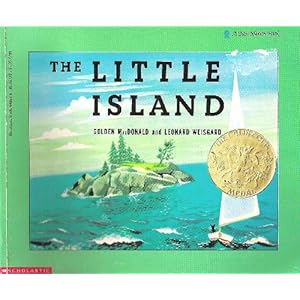
Title: The Little Island
Author: Margaret Wise Brown
Illustrator: Leonard Weisgard
Age Level: 5-8
Rating: 3 out of 5
Summary
The Little Island is about life on a secluded island. The book describes the activity that happens on the island and the changes that come with different seasons and night and day. A little kitten comes to the island and is very intrigued by the fact that the island considers itself part of the rest of the land that makes up the world.
Opinion
I chose to read this picture book because it won the Caldecott Medal and I was searching for a book about the ocean for my child study student. I thought that this book had very appealing illustrations which look to be done with watercolors or paint. The illustrations are very bold and draw your eye in which allows you to really paint a mental image of what is going on in the book. The book is set up with the text on the left page and the images on the right page which allows for consistency in reading which is something that I think is important for early readers. On some of the pages with text, there are also black and white pictures in the bottom corner which add a unique element to the illustrations. I did think that some of the dialogue in this book was a bit confusing. I didn't like how the author worded some of her sentences because they were really choppy and didnt flow which made understanding what was happening more difficult and this may be a problem for younger students.
Although this is a Caldecott winning book I do not think I would use it in my classroom as a future teacher. I did not find this reading to be very meaningful and I don't think that I could draw future discussion from the content in this book. I read this book with my child study student and she found it a bit difficult to understand. When I asked her to summarize what she thought the book was about she was not able to do this accurately.
Monday, September 13, 2010
Author: Karen Hesse
 Karen Hesse is an award-winning author of many childrens literature and young adult books. She was born in 1952 and grew up in the town of Baltimore, Maryland. While growing up she realized that she had a way with words and enjoyed writing very much. It was said that she would hide in her closet after school and write poetry in a notebook for hours. She got her inspiration and support from her fifth grade teacher, Mrs. Datnoff, who instilled the belief that she could and would become a professional writer some day. In 1969 she attented Townson State College in hopes of being a theater major but just two semesters later she transfered to the University of Maryland. There she recieved her B.A. in English along with two minors in Psychology and Anthropology. She has dabbled in many different job areas including being a book reviewer, waitress, typsetter, advertising secretary, proofreader, agricultural laborer, substitue teacher, and mental-health-care-provider. During her work in all these jobs she claims she never lost focus from writing poetry, stories, and books.
She later went on to write and publish 18 books which have been translated into several different languages such as Chinese and Spanish. She also recieved awards and honors including the International Reading Association Children's Book of the Year, National Jewish Book Award, Sydney Taylor Award, and Best Books for Young Adults and Notable Books selections.
I have never heard of Karen Hesse until I started researching for this project and I was amazed at some of the work she has accomplished. I think that her story is inspirational in that she never gave up her dream of being a writer and looked to those who gave her support and hope and ultimately reached her utmost goal in life. I was very impressed with her writing skills and story line in many of her books. She uses her excellent writing abilities to convey messages that challenge the readers. She has stated that her books are absolutly suitable for young readers because they provide substance and a chance for the reader to relate outside ideas and concepts to what is being read. Something that I picked up on as I read some of her work.
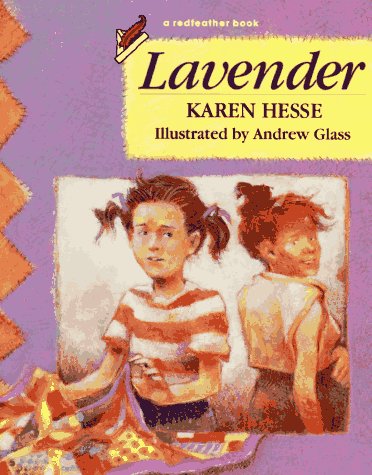 I particulary liked the book Lavender becuase it tackled a topic that many young children may be facing; the fear of change. Codie has a very strong relationship with her aunt Alix but her aunt is now pregnant and Codie fears that aunt Alix will no longer have time for her. I thought that this was a great book that can show kids that change is sometimes wonderful which, I know from experience, is something that many children have problems with. The storyline also encounters the importance of family and this was something that I was able to easily relate to and something that children will be able to relate to also.
A lot of Karen Hesse's books would be very beneficial to use in the classroom for children in 4th-6th grade. Her books tackle concepts that deal with the dust bowl, being human, the importance of family, and other historical issues. Any of her books could be the center of a unit and much discussion could be held from the content of them.
Information from:
http://www.edupaperback.org/showauth.cfm?authid=56
http://www2.scholastic.com/browse/contributor.jsp?id=3214
Subscribe to:
Posts (Atom)